After the War: A Horse That Tested the World
This was a royal ritual to show that peace had returned and that other kingdoms accepted his rule.As part of the ritual, a sacred horse was released to wander through many lands.
Any king who stopped the horse had to fight. Any king who let the horse pass was accepting Yudhishthira’s authority.
Arjuna was chosen to guard the horse. He had already fought in the greatest war of his time.
Now he had to protect peace with the same bow that once brought destruction.
The horse traveled across many kingdoms. Arjuna fought several battles on the journey—against groups like the Trigartas,
the Saindhavas, and also against Vajradatta, the son of Bhagadatta, who attacked with a mighty elephant.
Arjuna defeated these challenges and kept the horse moving forward.
But the most important fight on this journey was not against an enemy.
It was against his own son.
Arjuna’s Son in Manipura
Many years earlier, during exile, Arjuna had visited the kingdom of Manipura.
There he married Princess Chitrangada. He lived with her for three years.
During that time, she gave birth to a son—Babhruvāhana.
Arjuna later left Manipura and continued his life’s journey. Babhruvāhana grew up in his mother’s kingdom
and eventually became its king.
Now, during the Ashvamedha, the sacred horse entered Manipura.
Babhruvāhana heard that his father had arrived.
He did not come out to fight at first. He came respectfully to greet Arjuna.
He came like a son meeting a father.
But Arjuna was not pleased. He told the young king that a Kshatriya (a warrior king)
must respond properly to the horse’s challenge. To only greet him, without a formal challenge, was not correct.
These words hurt Babhruvāhana deeply. He felt ashamed. He had come with love,
but he was being judged as a king.
Ulūpī’s Role: A Hard Kind of Love
At that moment, another important figure appeared—Ulūpī.
Ulūpī was also one of Arjuna’s wives, a princess of the Nāgas.
She spoke to Babhruvāhana and said, “I am your mother.”
Then she urged him to fight his father.
Babhruvāhana was confused and troubled. But he listened.
After hearing Ulūpī’s words and remembering Arjuna’s rebuke, he made up his mind.
He would fight.
But then his courage and duty as a warrior-king might have remained unproven in the eyes of his own people.
The Battle Between Father and Son
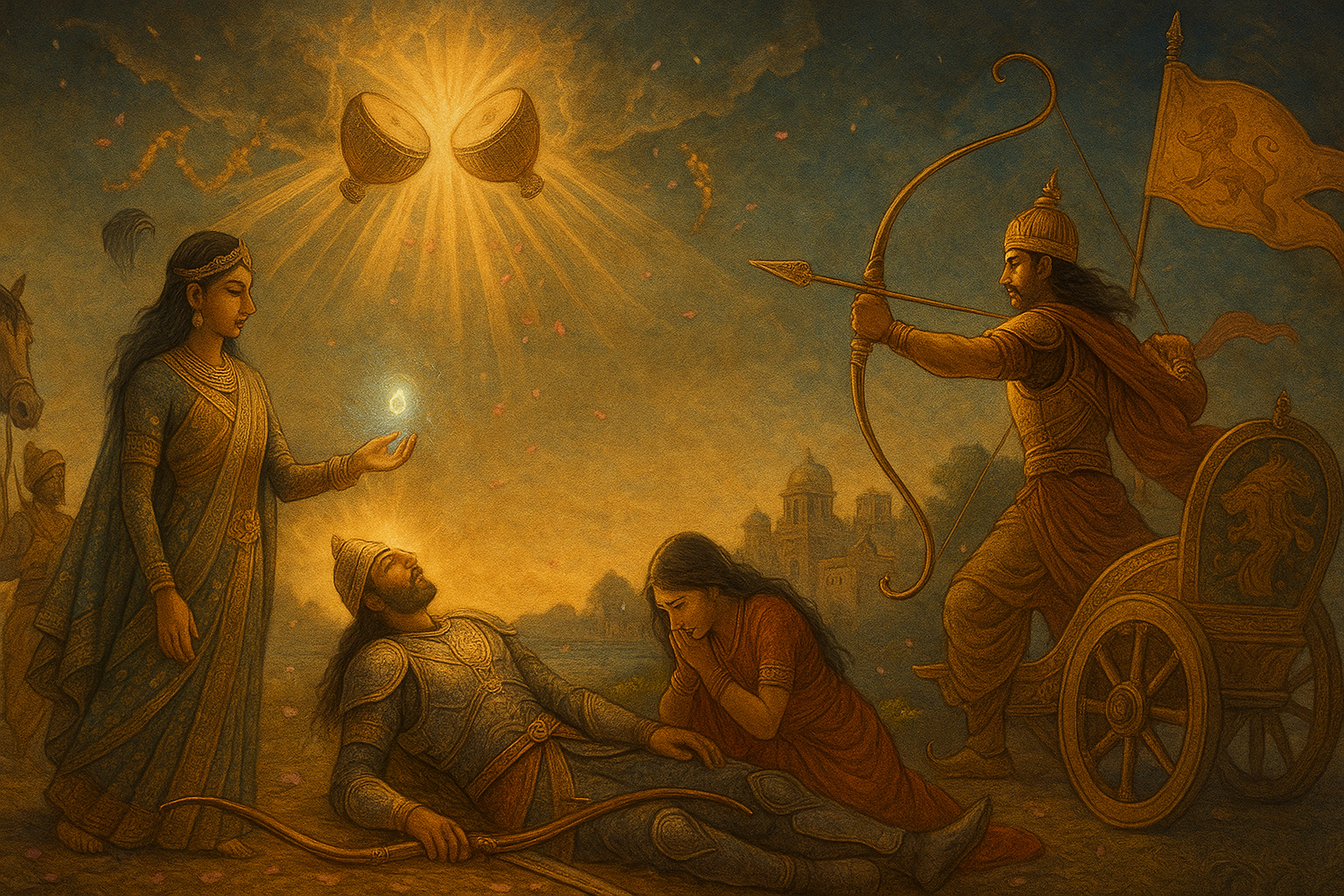
Babhruvāhana prepared for battle. He wore shining golden armor and mounted a fast chariot.
His banner carried the sign of a golden lion.
The duel began. Arrows flew from both sides. The sound of bowstrings filled the air.
But the story makes one point clear: Arjuna did not wish to hurt his son too much.
He fought, but he held back.
Babhruvāhana fought with full strength. He had to prove himself as a king.
The battle grew intense.
Then, suddenly, Babhruvāhana struck Arjuna down.
The mighty warrior fell to the ground and lay still.
To everyone watching, Arjuna appeared dead.
But then Babhruvāhana might have been publicly crushed, and his kingship could have been weakened.
Arjuna’s restraint changes the meaning of the fight.
Grief in Manipura
When Chitrangada saw Arjuna fallen, she was overwhelmed by sorrow.
She cried and lamented in many ways. She fell to the ground in grief.
She held her husband’s feet and wept.
Babhruvāhana was also shattered. He had fought to defend his honor,
but now he believed he had killed his own father.
He felt deep guilt. He declared that he did not wish to live after committing such a terrible act.
The whole city seemed filled with sorrow.
The Miracle: Arjuna Returns
Then something extraordinary happened.
Heavenly drums sounded in the sky. Voices praised the moment.
And Arjuna rose again—restored to life.
This was not random. Ulūpī had guided events toward a deeper purpose.
After Arjuna revived, he asked Ulūpī why she had caused such pain.
Ulūpī explained her reasons—about duty, protection, and what was necessary.
Through this event, Babhruvāhana proved himself as a warrior-king,
Arjuna fulfilled his role, and the family bond was restored.
But restoration turns tragedy into reconciliation.
Arjuna’s Response: A Father’s Forgiveness
After everything, Arjuna did not show anger.
Instead, he comforted his son.
He said Babhruvāhana had acted according to the duty of a Kshatriya.
Even though he had fought against him, he had done what a warrior-king must do.
This is what makes the episode powerful:
Arjuna is not only a great archer here—he is also a father who chooses forgiveness.
Why This Episode Matters
The Ashvamedha was meant to bring political unity.
But in Manipura, it became something deeper.
It tested honor, duty, love, and forgiveness—all at once.
In other kingdoms, Arjuna defeated enemies.
In Manipura, he helped raise his son’s status and strength.
The sacred horse continued its journey after this.
But the true victory at Manipura was not just political.
It was emotional: a family was shaken, and then healed.
